

https://www.realcleardefense.com/articles/2026/07/10/a_decapitated_triumph_why_irans_survival_is_not_a_strategic_victory_1193637.html


A Decapitated Triumph: Why Iran’s Survival Is Not a Strategic Victory
By Meda Parameswara Reddy
July 10, 2026
Thomas Friedman, writing in the New York Times on the day the Islamabad Memorandum of Understanding was signed, quotes the treaty’s own language to make his case. The United States, he argues, secured from Iran only “the safe passage of commercial vessels with no charge for 60 days only” through the Strait of Hormuz. Sixty days. After billions of dollars of bombs. He calls it a real-estate bankruptcy filing. He concludes: “There is a new sheriff in town. Dial 1-800-Ayatollah.”
Friedman is right about the treaty text. He is right about Trump’s midterm motivations. He is right that Iran’s nuclear program, ballistic missiles, and proxy networks are entirely unaddressed by this framework. These are serious analytical points from a serious columnist, and they deserve a serious answer — not a dismissal.
The answer is this: Friedman has fused two categorically different things — Trump’s political failure and America’s material failure. They are not the same. And in fusing them, he has made the same category error that Iranian state television made when Ghalibaf called the MoU “a record of U.S. failure.” A regime’s desperate need to survive is not the same thing as a strategic victory. A country’s leader making a politically motivated off-ramp decision is not the same as the country running out of material power. Conflating these produces the headline Iran wants and obscures the actual balance sheet of this war.
The Hormuz Card: Friedman’s Evidence Against Friedman
Begin with the clause Friedman himself cites as the signature proof of American weakness: Iran commits to toll-free Hormuz passage for 60 days only. Friedman treats this as evidence of Iran’s retained leverage. In fact, it is evidence of the exact opposite.
The Strait of Hormuz carries roughly 20 percent of global oil trade. Iran’s decision to close it was the single most consequential strategic move of this conflict. It disrupted global supply chains, triggered energy price spikes, and provided Tehran with its only real leverage at the negotiating table. And Iran spent that leverage buying itself a ceasefire it desperately needed to stop the physical dismantling of its military infrastructure.
A nation that plays its most powerful card — the card that brought global commerce to a halt — and receives in return 60 days of toll-free passage and a conditional reconstruction fund has not demonstrated leverage. It has revealed its ceiling. Furthermore, by demonstrating its willingness to weaponize that chokepoint, Iran has provided every energy-dependent nation in the world with a permanent, visceral incentive to reduce its exposure to Iranian geography. The pipelines, alternative routing strategies, and supply chain diversification efforts now underway are not temporary adjustments. They are structural responses to a proven threat. Iran played the Hormuz card once. It will never carry the same surprise value again.
Trump’s Failure ≠ America’s Failure
Friedman argues, correctly, that Trump’s decision to accept this framework was driven by domestic political calculation — that food inflation and gasoline prices triggered by the war were a prescription for a Republican wipeout in the November midterms. He is also correct that Trump abandoned Israel and the Gulf Arab states in service of swing-state politics in Pennsylvania, Georgia, and Michigan.
These are legitimate criticisms of a president. They are not evidence of diminished national power. The United States entered and exited this conflict with a $30 trillion GDP and an estimated $160 trillion in total national wealth. Its military and industrial base is intact. Its strategic relationships, however strained, remain anchored in durable security architecture. Washington chose a political off-ramp. It was not forced to one by exhaustion of national capacity. That distinction is fundamental to any serious analysis of what this conflict settled.
Friedman himself acknowledges this — implicitly — when he asks whether Trump can “salvage a good outcome in Iran.” If the United States had actually lost, that question would be moot. The question exists because the outcome remains open. Iran signed a 60-day extension to negotiate a final deal on terms that still include its nuclear program, its ballistic missiles, and its proxies — all unresolved. The leverage to shape that deal has not evaporated. It depends entirely on whether the next 60 days are managed with strategic discipline or with the same carelessness Friedman rightly criticizes.
What the Material Balance Sheet Actually Shows
Set aside the political narrative and examine what each party brought out of this conflict in purely material terms.
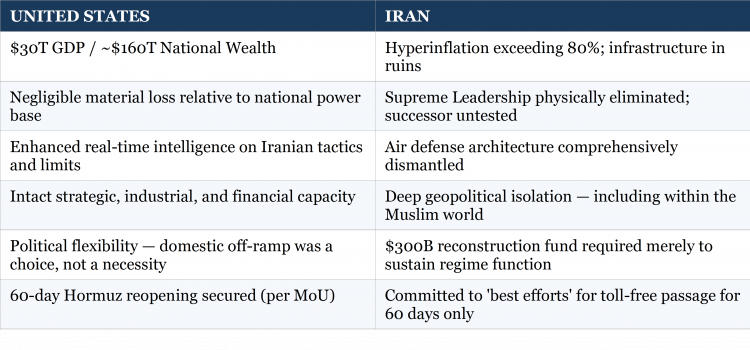
Iran’s supreme command structure was physically eliminated — an event without modern precedent in nation-state conflict outside of total defeat. Its air defense grid was comprehensively dismantled. Its economy is in hyperinflationary collapse, requiring a $300 billion international reconstruction fund as a condition of the ceasefire — a lifeline, not a prize. Its neighbors, including the Muslim-majority states it spent decades claiming to champion, watched Iranian missiles cross their territory and are now actively exploring security arrangements designed to permanently reduce their exposure to Tehran.
Against this, the United States expended materially negligible resources relative to its national power base. It emerged with a battle-tested intelligence picture of Iran’s exact tactical ceiling, its technological limits, and its operational boundaries. Every future engagement will be calibrated with a precision that did not exist before February 2026.
The Regime That Survived Its Own Execution
Friedman’s Nick Carraway metaphor — Trump and Vance as Tom and Daisy Buchanan, smashing things and retreating into carelessness — is rhetorically effective and politically warranted. Trump’s management of this conflict has been, by many measures, strategically incoherent. The criticisms of his conduct are valid.
But a country’s president can fail at strategy while the country itself retains its material power. And a regime can survive while forfeiting the structural foundations of its long-term strength. Iran’s new supreme leader inherits a decapitated security architecture, a hollow economy, a hostile neighborhood, and a nuclear program still under international pressure with no final deal in sight. The new sheriff Friedman describes rules over a fractured kingdom.
Surviving an execution is not the same as winning a war. Iran survived. The bill for that survival will be paid for a generation.
Meda Parameswara Reddy, Ph.D. is Director of the Reddy Center for Critical and Integrated Thinking. A former R&D executive holding 30 U.S. patents, he focuses on the analysis of human behavior, public health, and global affairs, drawing on a deeply interdisciplinary scientific background. His work has been published in RealClearScience, RealClearMarkets, RealClearDefense, AFRO American, South Asia Monitor, where he serves on the editorial board, and others. mpreddy54@yahoo.com | mpreddyinsights.com.
image: Mourners write messages on a wall, including one in English that reads “We will kill Trump,” during the funeral ceremonies for slain Iranian Supreme Leader Ayatollah Ali Khamenei and members of his family at the Imam Khomeini Mosalla Grand Mosque in Tehran, Iran, Saturday, July 4, 2026. (AP Photo/Altaf Qadri)